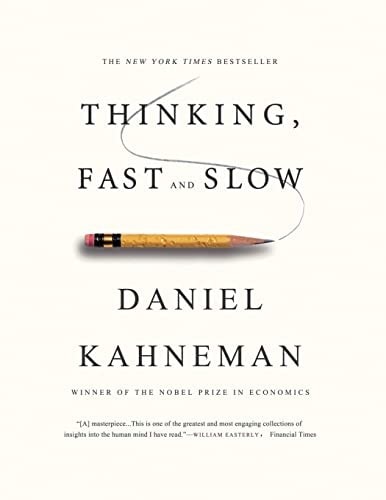
Thinking, Fast and Slow
Kahneman
First published 2011Farrar, Straus & Giroux first edition, 25 October 2011 (Penguin Random House)
What it is.
System 1 vs. 2, and why the effortless default usually wins over the rational choice.
Kahneman's claim is that nothing is wrong with the rational model, the human in it is not the human in the room. Two systems run the mind, one fast and automatic, one slow and effortful, and the fast one is doing almost all the work. The errors that follow are patterned rather than random, which is what makes this economics rather than psychology. It is also the book that gave me the words. I had been poking at the rational actor in coursework without being able to name what was wrong with it.
Working summary · based on Toward's reading notes
The strongest objection
The priming chapter has not held up. Several of the social-priming studies it reports failed to replicate, and Kahneman himself later conceded that section rested on evidence too weak to carry it.
Working summary · based on the book itself
Why it is here.
A default is the option you get when you do nothing. Changing takes effort, so most people stick with it. Whoever sets it shapes the outcome.
The defaults principle cites three books and this is the one furthest from practical, deliberately. Nudge and Misbehaving tell you what to build. This tells you why building it works, which is that the effortless option beats the considered one more often than anyone wants to admit.
Working summary · based on Toward's records
Where it sits.
Goals it serves.
Read it before Nudge, which applies it, and before Misbehaving, which tells the field's own history. It is the foundation the other two stand on, so reading it last makes them feel more original than they are.
Working summary · based on Toward's records