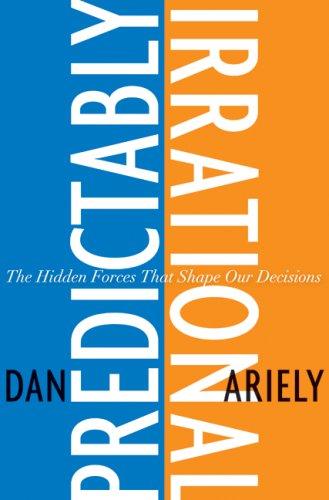
Predictably Irrational
Dan Ariely
First published 2008HarperCollins first edition, 19 February 2008
What it is.
A first tour of the idea that context shapes choice. Read it knowing the field has since split the book's own findings — the zero-price effect held up, the anchoring experiments largely did not, and the honesty studies are retracted or under investigation.
Ariely's frame is that our mistakes are systematic rather than random, so once you see the system you can predict them. Most of the book is experiments showing choices bending to things that should not matter. What sits next to an option changes how good it looks. A price you just saw sets what the next one feels like. Free is not a low price, it is a different category. The one that stays with you is social norms against market norms.
Working summary · based on the book itself
The strongest objection
Method. Cialdini went into the field and Ariely mostly runs students in a lab, which is worth knowing before carrying any single result out into the world.
Working summary · based on the book itself
Since it was published.
Worth knowing before you take any one finding here as settled. The best known experiment in this book, where recalling the Ten Commandments made people cheat less, did not hold up when many labs ran it again under one preregistered protocol, and the pooled result pointed very slightly the other way. Separately, a later paper Ariely co-authored was retracted after other researchers questioned whether its data were valid. That paper is not in this book, its retraction notice names five authors and assigns responsibility to none of them, and the university inquiry that followed has not been made public. So the honest position is that the record here is unsettled rather than decided either way.
Replication: Verschuere et al. (2018), Advances in Methods and Practices in Psychological Science 1(3):299-317, a Registered Replication Report on Mazar, Amir and Ariely (2008) Experiment 1. Twenty-five direct replications, N = 5,786; the 19-replication primary meta-analysis found participants reported solving 0.11 more matrices after a moral reminder, 95% CI [-0.09, 0.31], Cohen's d = -0.04 against the original 0.48. Retraction: PNAS, 21 September 2021, “Retraction for Shu et al., Signing at the beginning makes ethics salient” (10.1073/pnas.2115397118), whose stated ground is that “Simonsohn, Simmons, and Nelson have provided evidence to question the validity of the data in the article”; the notice names five authors and assigns differentiated responsibility to none. Duke's report is confidential and Duke declined to confirm its contents to the Chronicle of Higher Education, leaving Ariely the only public source for what it found. Checked 2026-08-25.
Why it is here.
A social norm is your read on what people like you actually do, and you quietly drift toward it. Show someone that their neighbors use less, and they use less too, without anyone telling them to.
It is here for the social norms half, not the famous experiments. That chapter is the sharpest statement of a problem this site keeps hitting. Attach a payment or a points balance to something people were doing for their own reasons and you replace the reason, and removing the payment does not bring it back.
Working summary · based on Toward's records
Where it sits.
Goals it serves.
Read it after Influence and the overlap is obvious. If you keep one chapter, keep the one on social and market norms, which is the half the sustainability tool here rests on.
Working summary · based on Toward's records