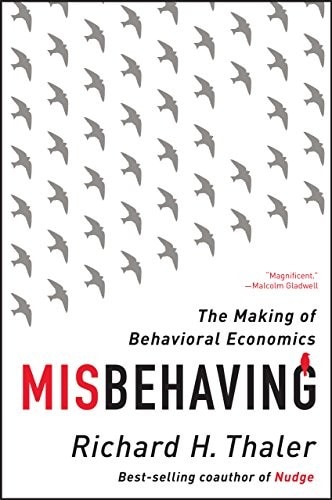
Misbehaving
Thaler
First published 2015W. W. Norton first edition, 2015 (publisher's own title page)
What it is.
How "Save More Tomorrow" went from idea to real retirement policy.
This is the field's own history, told by the person who caused a lot of it. Thaler starts from the anomalies traditional economics filed under noise, the cases where people reliably do not do what the model says, and follows them through decades of arguing with colleagues until behavioral economics has a seat at the table. It reads like a memoir, which is the reason to read it. You watch an idea get built instead of being handed the finished version.
Working summary · based on Toward's reading notes
The strongest objection
The standard counter is that what matters is how people act, not how they say they act. Fair, and it skips the experiments in this book that watch behavior instead of asking about it.
Working summary · based on Toward's reading notes
Why it is here.
A default is the option you get when you do nothing. Changing takes effort, so most people stick with it. Whoever sets it shapes the outcome.
Save More Tomorrow is the reason it is on this shelf. It is the cleanest case in the literature of a default doing work that no amount of good advice does. You commit now to saving more out of raises you have not received, so the money never feels lost, and leaving takes an action nobody gets round to.
Working summary · based on Toward's records
Where it sits.
Goals it serves.
Third of three, and fine to read last. Thinking, Fast and Slow is the psychology, Nudge is the application, and this is the argument that had to be won in between.
Working summary · based on Toward's records